David Guetta is the world’s number one DJ, but what does that actually mean?
Lemme start off this newsletter by welcoming all of our new subscribers, we picked 20 new subscribers in the last week, which is pretty astounding.
Welcome aboard. You've joined at an exciting time, but I think FrontLeft is always exciting, so maybe I'm biased.
I'm writing this on a Sunday after getting in at 8am on Sunday morning. I don't stay out all night that often now, but when I do it means I get to indulge in one of my favourite parts of the clubbing experience. It has nothing to do with being in a club, but the morning after, when you're at home, the night has caught up with you and all you really want to do is sprawl on the sofa/bed/floor and listen to some music.
There's a particular pleasure in putting on a good playlist when you're feeling a bit worse for wear. Not necessarily the biggest tunes from the night before, or the sort of music you'd normally spend three hours sweating to in a dark room. Sometimes it's something gentler, downtempo stuff that reminds you of a particularly good night out, sometimes it's just a collection of records that make being awake feel slightly less offensive.
The beauty of a playlist here is that, unlike a DJ set, it doesn't have to take you anywhere in particular. You don't need something to build towards a big moment or designed to keep a dancefloor moving. You can just let the music happen around you while you try to remember whether you've eaten anything resembling a vegetable in the last 24 hours.
I've always liked the idea that music can change the shape of a day without necessarily changing what's happening in it. The washing still needs doing. Your WhatsApp is still full of messages you need to respond to, or that cursed Duolingo Owl pleading with you to learn some Spanish. But a good run of tunes can make all of that feel a little less grim.
There's also something lovely about rediscovering music outside the context in which you normally hear it. A track that absolutely destroyed you at 4AM can sound completely different playing on your bedroom speaker at 2PM. Something you barely noticed in a club suddenly catches your attention. You hear a vocal, a little synth line, or a drum pattern that got lost somewhere between the strobe lights and the person repeatedly bumping into you on the dancefloor.
And sometimes you don't want anything particularly clever at all. You want music that makes you feel good, and you want it loud enough to drown out the voice in your head asking why you thought three more hours at the afters was a sensible idea.
So, if you're reading this while nursing a coffee, attempting to re-enter polite society or wondering whether it's too early to order something greasy, consider this your permission to do absolutely nothing productive for a bit. Put on a playlist, have some water, and consider whether you really need to do anything else today. ideally before your body starts sending increasingly insistent complaints.
You've probably earned a quiet morning. And if you happen to find a new favourite tune along the way, even better.
The Mix
Something a little special here, a mix from my friend Daria, who hasn't played out yet but has put out a few solid mixes over the past couple of months. Her Autumn '26 mix is some deep house that feels really distinct. As ever, listen below on the website, but you'll need to click through to SoundCloud to listen along if you're reading us by email.
DJ Mag's Top 100 is a popularity contest, not a ranking of the world's best DJs
There are plenty of ways to measure the success of a DJ. You could look at the records they’ve released, the influence they’ve had on the music being made around them, the crowds they can draw into a club, or the number of people willing to spend a frankly unreasonable amount of money to see them play in a field. Or you could ask the public to vote for their favourite and pretend the result tells us who the best DJ in the world actually is.
Guess which approach DJ Mag has taken for another year, releasing their Top 100 list for 2026.
David Guetta has once again claimed the top spot in the DJ Mag Top 100 DJs poll, securing his sixth victory and reinforcing his position as one of electronic music’s most recognisable commercial figures. It is an impressive achievement, in the same way that repeatedly winning any popularity contest is an impressive achievement. But if the list is supposed to tell us anything meaningful about the state of electronic music, it might be time to admit that we’ve outgrown it.

The DJ Mag Top 100 continues to conflate commercial success (and popularity) with DJing excellence, as if those two things are interchangeable. They aren't, and the fact that we still treat them as though they are says a lot about how archaic the entire exercise has become.
To be fair to DJ Mag, the Top 100 has never been particularly shy about its methodology. It is a public vote, open to anyone, with no nominations or eligibility criteria. In theory, that makes it democratic. Anyone can vote for their favourite DJs, regardless of their musical taste or where they spend their weekends. In practice, it means the results reflect a combination of name recognition, fan mobilisation, commercial reach and the ability to persuade people to click a button.
Those are all perfectly legitimate measures of popularity. They are not particularly useful measures of who is the best DJ.

A DJ with a huge global fanbase, a major label behind them and a marketing operation capable of reaching millions of people has an enormous advantage over someone who spends their weekends playing technically brilliant, musically adventurous sets in small clubs. The latter might be shaping the sound of an entire scene, introducing audiences to new records and inspiring a generation of selectors. The former might be playing a carefully rehearsed sequence of festival anthems to 50,000 people. Both have their place, but why are we pretending they can be evaluated using the same metric?
The Top 100 has always favoured the commercially accessible end of electronic music. That's understandable given its origins and enormous audience, but the apparent availability of website advertising encouraging people to vote for particular DJs raises further questions about how commercial interests intersect with a supposedly democratic poll.
Dance music has expanded enormously since the poll began in 1993. Its global culture encompasses everything from underground techno and experimental club music to UK garage, hard house, jungle, minimal, Afro-house and countless other sounds that don't fit neatly into the "big room" DJ model.
A single ranking is an increasingly absurd way to represent that diversity.
Guetta's victory is the clearest illustration of the problem. He is a hugely successful producer, a recognisable public figure and an accomplished businessman who has spent decades making electronic music accessible to enormous audiences. None of that is in dispute. But is he really the DJ who best represents where electronic music is heading in 2026? Is his work the most exciting, influential or musically important of anyone in the poll?
I find that much harder to believe.
Guetta feels like a legacy act whose position at the top of the ranking owes as much to familiarity as it does to his relevance to contemporary club culture. For a large section of the public, he is what a famous DJ looks like: the name attached to enormous hits, festival headlines and glossy Ibiza residencies. His name carries an immediate association with dance music, even among people who couldn't tell you what has been happening on the dancefloor at Fold, in a basement in Berlin or at a club night in Manchester.
That recognition is powerful, but it also makes the Top 100 feel horribly out of date. Guetta remains a hugely successful artist, and it would be absurd to suggest that nobody cares about his music. The question is whether commercial success and decades of name recognition make him the most interesting DJ in the world right now. To anyone trying to understand the most exciting developments in club culture, his position at the top of the poll tells us remarkably little.
There is a difference between being one of the most famous people associated with dance music and being the DJ you most need to hear. The Top 100's title suggests the latter, while its voting system rewards the former. Guetta's victory tells us that he remains one of electronic music's most recognisable names. It tells us considerably less about the quality of his sets, the records he champions or his influence on the people pushing the music forward.

And if the answer to the question of who is the world's best DJ is simply the person most people recognise, we might as well give the award to whoever has the biggest Spotify profile.
The other problem with the Top 100 is how little it reflects the diversity of the scene it claims to represent. For all the talk of electronic music being a global culture, the upper reaches of the list remain stubbornly homogeneous. There are just two women in the top 20 this year, which seems a particularly poor reflection of a scene in which women are playing some of the most exciting sets, running influential labels and helping shape the sound of contemporary club music. In the top 100 there are just 14 women represented. Which blows my mind.
Across all genres, in clubs and on SoundCloud, there are women whose influence extends far beyond their position on a popularity poll. Yet the Top 100 still struggles to reflect that breadth, particularly towards the top.
Popularity doesn't exist in a vacuum. Visibility, marketing budgets, access to major festival stages and the ability to mobilise enormous online fanbases all influence who gets noticed. When women already face barriers to bookings and disproportionate scrutiny online, a voting system driven by name recognition is unlikely to correct those imbalances. It risks reproducing them.
The problem, then, isn't simply that the wrong people are winning. It's that the system rewards a narrow definition of success, one that favours established names and commercial reach over a broader understanding of who is contributing to electronic music. If the Top 100 cannot adequately reflect the diversity of the scene it celebrates, that's another reason to question what, exactly, it is measuring.
There are encouraging signs that the poll is beginning to catch up with the music. Charlotte de Witte has climbed into the upper reaches of the rankings, Anyma has become a major force in the festival circuit even if he's not to my tastes, and Fred Again has built a huge following by bringing a different sensibility to mainstream dance music. House and techno artists are finding larger audiences, while newer names are increasingly able to turn online momentum into international bookings.
These artists demonstrate that electronic music's mainstream continues to evolve, with house and techno finding larger audiences and artists from different corners of the scene translating their work into international success. That movement is welcome. But why should a popularity poll be responsible for validating artists whose importance can already be understood through their music, their audiences and their influence on the wider scene?
The most interesting DJs aren't necessarily the ones playing the biggest stages. They might be the selectors taking risks in small rooms, the residents who understand precisely what a dancefloor needs at 4am, or the artists whose productions are changing what other DJs play. They might be the people building communities around a club night, creating space for emerging talent or bringing sounds from one scene into another.
These contributions are difficult to reduce to a number. That doesn't make them less important. If anything, it suggests we need a better way of recognising them.
A list that claims to identify the world's best DJs should at least attempt to account for the craft of DJing. Musical selection, technical ability, versatility, innovation, crowd reading and cultural influence all deserve consideration. So does the ability to make a set feel like something that could only have happened in that room, at that moment.
None of these qualities is easy to measure objectively. But that isn't an excuse to abandon the attempt and let a public vote do all the work.
I'm not suggesting that DJ Mag should scrap the Top 100 altogether. There is value in a global poll that captures which artists have captured the public imagination, and the list remains a useful snapshot of commercial dance music. Its longevity and reach are impressive, and the continued interest in the results demonstrates that people still care about it.
But we should stop pretending that popularity is the same thing as quality.
A better approach would recognise that there are different ways to be an exceptional DJ. A critics' panel could assess musical innovation and technical ability, while a separate public vote could celebrate popularity. Dedicated genre rankings could give scenes their own space, rather than forcing wildly different artists into a single hierarchy. Clubs, promoters, journalists and fellow DJs could all contribute perspectives on the people doing the most interesting work.
Such a system would also give us an opportunity to look beyond the same familiar names and recognise a broader range of artists. Not because diversity should be a box to tick, but because a genuinely representative picture of electronic music ought to reflect the people actually making it what it is.
None of this would produce a perfect list. Any attempt to rank something as subjective as DJing will inevitably involve disagreement, bias and arguments about whose taste counts. But at least it would acknowledge that the question is complicated.
The point isn't to replace Guetta with someone more underground and declare the problem solved. That would simply create a different version of the same argument. It's to recognise that no single DJ can reasonably be declared the best in the world without first deciding what being the best actually means.
Until then, the DJ Mag Top 100 will continue to tell us which DJs have the biggest fanbases, the broadest reach and the most effective campaigns to get people voting. That's useful information, but it isn't the same as telling us who is doing the most interesting work behind the decks.
The best DJ in the world might be playing to 50,000 people at a festival. They might also be playing to 200 people in a basement at 4am, taking a room somewhere nobody expected it to go. If we want to celebrate the people shaping electronic music, we need a way to recognise both. DJ Mag's poll has had more than 30 years to figure that out. Perhaps it's time we stopped expecting it to.
The Briefing
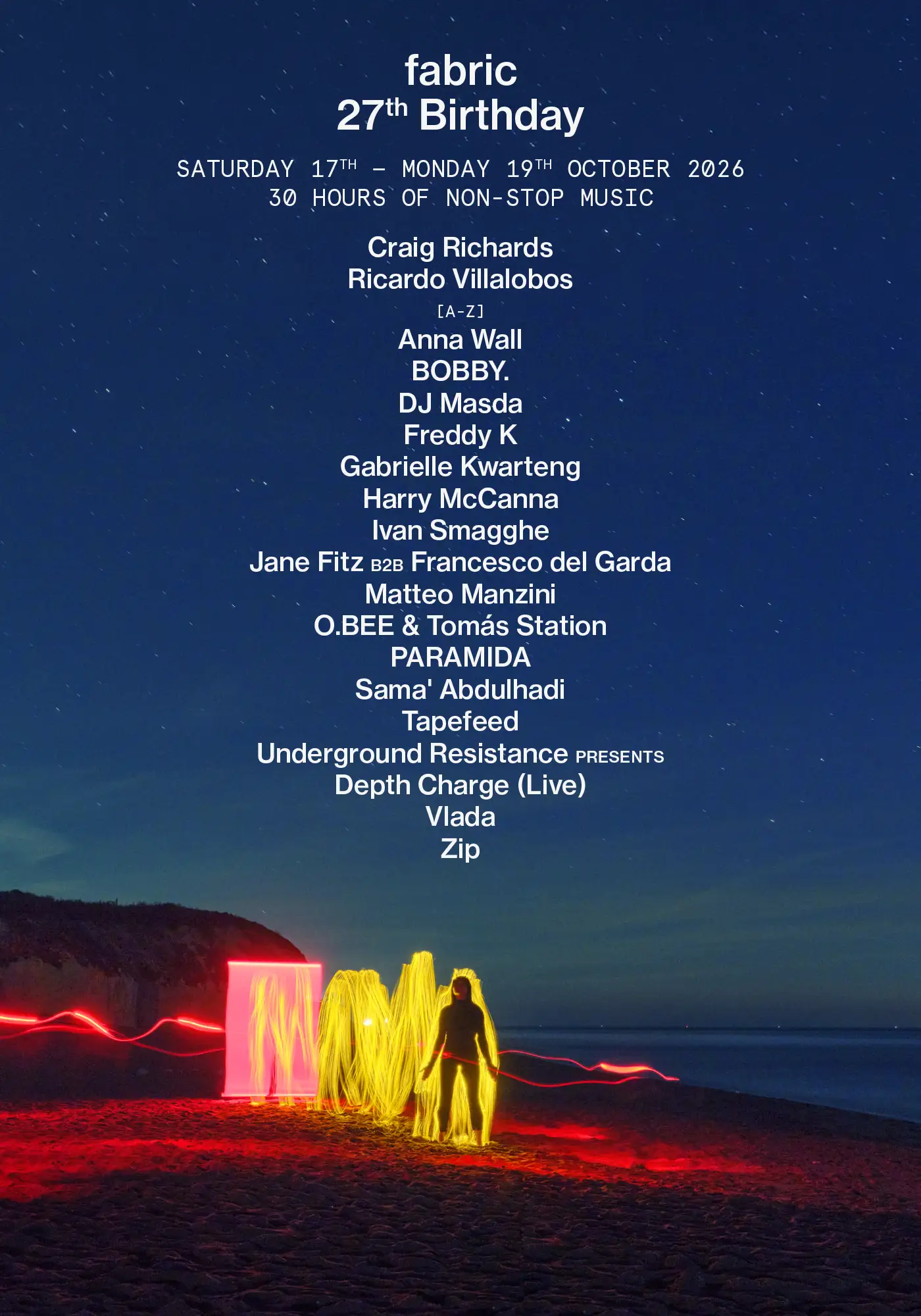
Lots of good stuff this weekend, but most people will be dipping into Fabric at least a little bit for the club's 27th birthday. Their Saturday-to-Sunday lineup is an eclectic mix, but that also means there's something for just about everyone.
Friday
- FABRICLIVE 27th BIRTHDAY - Girls Don't Sync, Osmosis Jones, Skee Mask, Smokey Bubblin' B Fabric
- Hernan Cattaneo & Danny Howells Koko
- Luke Una & Paula Tape Night Tales
Saturday
- Indira Paganotto, Lee Ann Roberts, Estella Boersma The Cause
- fabric 27th Birthday: Craig Richards, Ricardo Villalobos, Freddy K, Zip, DJ Masda, Jane Fitz Fabric
- Midland - All Day Long Fold
Sunday
What else?
- Teenage Engineering is going to stop making synthesisers. The company is famous primarily for those synthesisers, but they also made the portable handheld console the Playdate too. I've got one in a drawer somewhere!
- Hosts have been announced for GTA 6's radio stations and it's a who's who of musical talent. Robyn is hosting the pop radio channel! I am very excited about this news because, you know, Robyn.
- A new Spiritland listening bar is opening in the Barbican center, opening October 20 and will be open until July 2027, when the Barbican closes for refurbishment.
Member discussion